



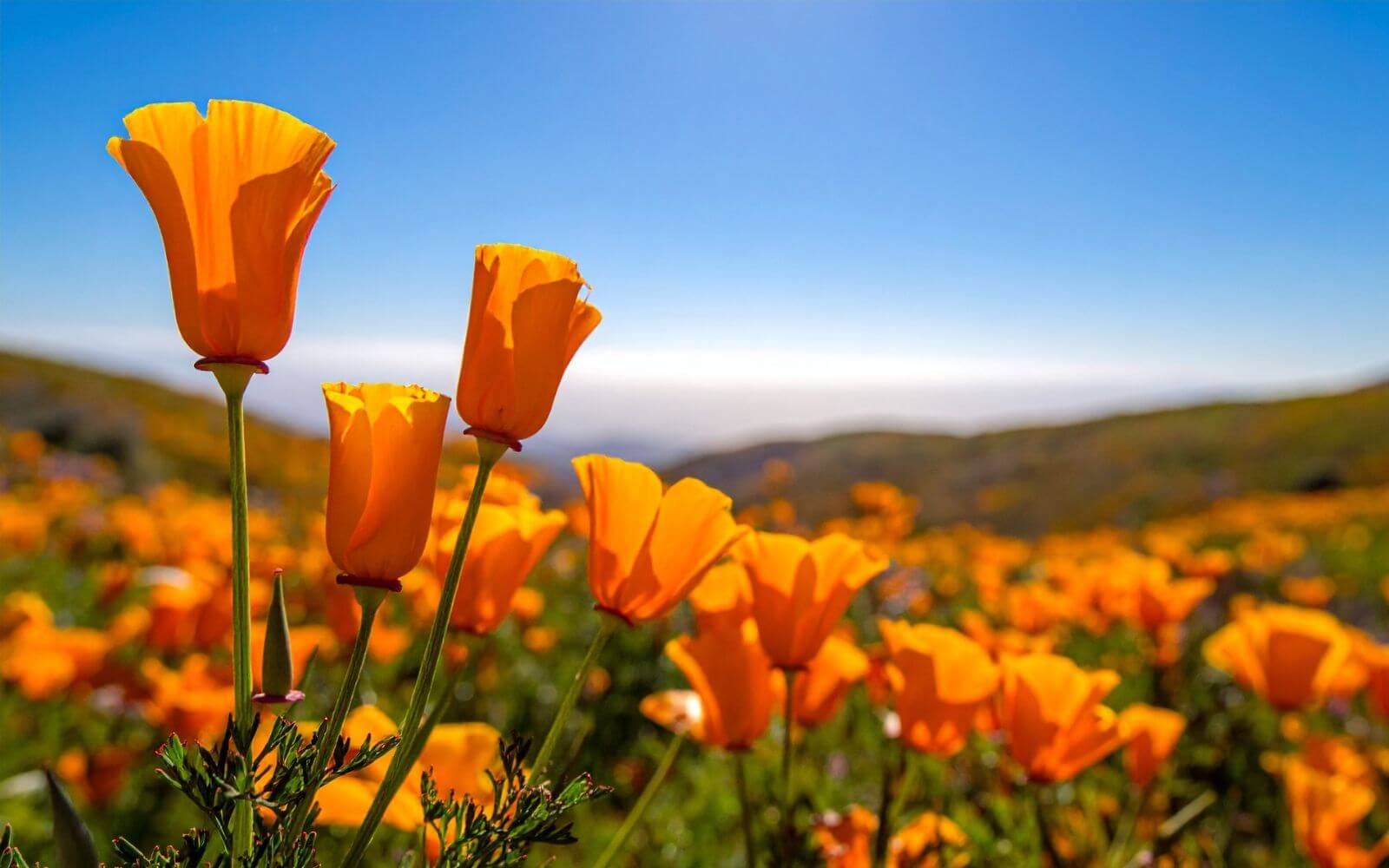
California Poppy to Support Relaxation and Ease Restlessness
California poppy (Eschscholzia californica) is among the most iconic wildflowers of North America. As the official state flower of California, it is widely recognized far beyond its native habitat.
Thanks to its unique spectrum of isoquinoline alkaloids, the plant has been studied for decades as a natural aid for nervous restlessness, sleep disturbances, and mild anxiety.
Botanical Profile
Eschscholzia californica belongs to the poppy family (Papaveraceae). This annual to perennial herb is native to California and the southwestern United States. It is particularly known for its bright orange-yellow flowers and finely divided blue-green foliage. Today, it is cultivated worldwide as both an ornamental and medicinal plant.
Unlike the opium poppy (Papaver somniferum), California poppy does not contain pharmacologically significant opiates such as morphine or codeine. Instead, its therapeutic properties are attributed to a range of other bioactive alkaloids.
Chemical Constituents
Phytochemical studies have shown that the aerial parts of the plant, and especially the roots, contain a diverse spectrum of isoquinoline alkaloids.
The most important identified compounds include protopine, allocryptopine, californidine, escholtzine, chelerythrine, sanguinarine, reticuline, and caryachine derivatives. In addition, flavonoids, particularly quercetin and isorhamnetin glycosides, as well as various carotenoids responsible for the flowers’ characteristic coloration, have been identified.
Calming and Sleep-Promoting Properties
California poppy is primarily used to support relaxation and healthy sleep. Research suggests that its alkaloids may interact with GABAergic signaling pathways as well as serotonergic receptors. These pharmacological effects are considered possible mechanisms underlying the plant’s sedative and anxiolytic properties.
Preclinical studies have not demonstrated the dependency issues commonly associated with conventional sedatives.
Anxiolytic Potential
The potential use of California poppy for mild to moderate anxiety has attracted considerable scientific interest. In a randomized, placebo-controlled clinical trial involving 264 participants, a combination of California poppy, hawthorn, and magnesium resulted in significant improvements in anxiety symptoms.¹
Although further research is needed, these findings support its traditional use as a botanical calming agent.
Analgesic Effects
Historically, Indigenous peoples of North America used the plant’s milky sap to alleviate toothache and nerve pain. Modern studies suggest that several of its alkaloids may possess pain-modulating properties, although the precise mechanisms of action remain under investigation.
Current Research Perspectives
Recent metabolomic analyses have identified more than 70 different secondary metabolites in extracts of Eschscholzia californica. In addition to antioxidant properties, researchers have investigated inhibitory effects on enzymes associated with neurodegenerative diseases.
Particularly interesting findings include:
• Potential acetylcholinesterase inhibition
• Antioxidant activity
• Inhibition of α-glucosidase and α-amylase enzymes
• Potential neuroprotective effects
• Activity on sleep-related signaling pathways
These findings position California poppy as a promising source for the development of novel phytopharmaceutical ingredients.
certified organic quality
We source our California poppy directly from the United States and can supply it in certified organic quality.
If you have any questions or would like additional information, please do not hesitate to contact our expert Dr. Sandra Miklos.
Reference
¹ Hanus M, Lafon J, Mathieu M. Double-blind, randomized, placebo-controlled study to evaluate the efficacy and safety of a fixed combination containing two plant extracts (Crataegus oxyacantha and Eschscholzia californica) and magnesium in mild-to-moderate anxiety disorders. Current Medical Research and Opinion. 2004;20(1):63-71.


 4c media