


Those Who Act Make History. A Cfm Museum as a Symbol of Change, Courage, and Vision
History does not always begin with a loud bang. Sometimes, all it takes is a dusty box in an attic. When old books, tins, and documents surfaced at Cfm, they initially appeared to be silent witnesses of a long past. For Managing Director Steffen Tropitzsch, however, they quickly became something tangible.
“Two hundred and thirty-eight years are abstract at first,” he says. “These objects create a sense of time and of change.”
What first seemed like a nostalgic discovery soon became the starting point for something much bigger. The impulse came from within the company itself. Team members were quick to say: We need to create something out of this.
From Idea to Mindset
It has been about three years since a passing thought turned into a real project – timed perfectly with the company’s 235th anniversary and helped along by a family clean‑out. A museum was to be created within the premises of Cfm Oskar Tropitzsch GmbH: a place that conveys change, courage, and foresight.
“When you look back that far, you see many difficult periods that were successfully overcome,” Steffen Tropitzsch explains. This awareness was meant to remain visible, alongside the lightness that gives today’s generations the confidence to carry the company forward. He sums up the museum’s central message succinctly: “Those who act make history.”
The First Vision Takes Shape
To bring the idea to life, Cfm brought in two long‑standing partners: Marc Eichner, responsible for concept, graphics, and storytelling, and Matthias Pausch, in charge of construction and craftsmanship.
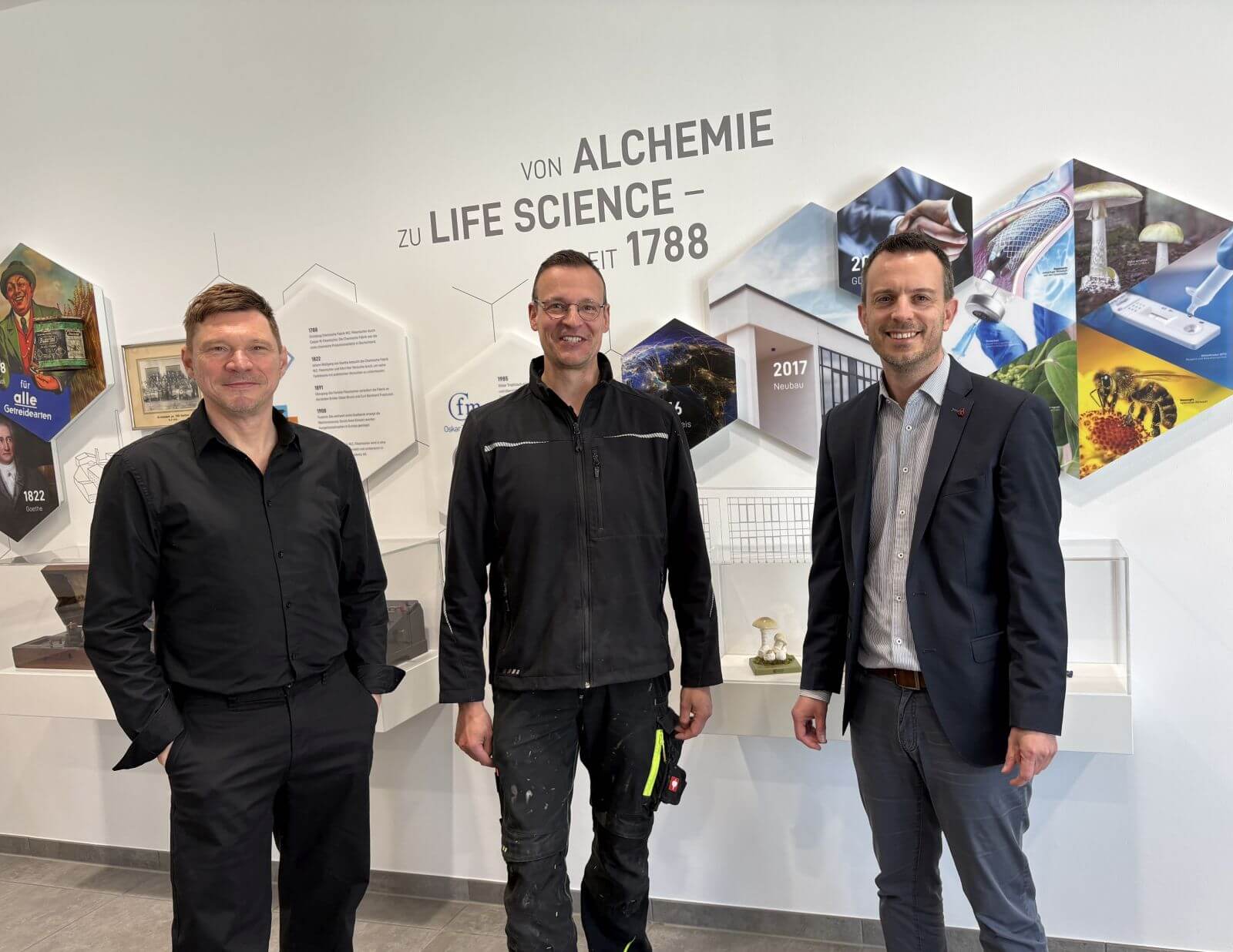
For Eichner, everything began with a site visit and a wall. After the initial meetings with project leads Corinna Schroller and Karin Bayer and an assessment of the space, he “sketched out a first idea relatively quickly.” The key concept: the exhibits should not disappear behind glass, should not feel “locked away.” Instead, they would appear to float freely on the wall, individually arranged, open, and accessible.
The way the company’s long history would be handled was also clear from the start. Rather than a closed chronological display, the exhibition would flow across the wall. Eichner describes it as a deliberate snapshot of an ongoing process: Cfm’s story is not finished. It is still being written.
Friendly, Not Dusty
What emotion should greet visitors first? For Eichner, the answer was clear: friendliness and approachability. No sense of intimidation, no prior knowledge required. The history was to be told in a modern, barrier‑free way. Visually light, open, and inviting.
This attitude is also reflected in the choice of materials. Together with Matthias Pausch, the team opted for lightweight, durable materials that are as non‑reflective and visually restrained as possible. “We tested samples and made joint decisions,” says Eichner, as it was clear early on that design and craftsmanship would need to dovetail seamlessly.
One detail that visitors may not consciously notice, but which holds special significance for Eichner, is the basic shape used for many of the panels. Molecular structures provided the inspiration. The hexagon became a recurring element. A subtle reference to the company’s chemical DNA.
When Design Meets the Workbench
For master carpenter Matthias Pausch, the real challenge began when concepts on paper had to become reality. The most demanding aspects were crafting the layered effects of the group collages and mounting the individual owner portraits onto the concrete wall.
“The tricky part was really just the installation,” he says matter‑of‑factly by which he means the level of precision that later becomes invisible.
Because the final appearance was clearly defined, material choices were both simplified and constrained. With the high‑gloss lacquer finish predetermined, only one material ultimately qualified for the core structures. The aim was for the furniture itself to recede into the background.
“The museum should speak for itself,” Pausch explains.
respecting the past, representing the future, without calling attention to itself.
He handled some historical objects with particular care, especially the old Fusariol tin and an ancient copying ledger that was painstakingly restored for this purpose. “These items don’t just carry history,” Pausch says. “They are history.”
Collaboration at Eye Level
The seamless interplay between design and execution was no accident. Eichner and Pausch have worked together for years. “A strong partner who thinks ahead and is reliable,” Eichner says. Pausch describes the collaboration as straightforward: “short check‑ins, clear roles.”
While Eichner provided the creative lead, Pausch contributed wherever he saw opportunities for improvement. This balance between a clear vision and hands‑on dialogue allowed many ideas to fully mature.
The moment when everything came together? For both, it was the same: after the final review, in the workshop, while unpacking the pieces and laying them out for the first time. Suddenly, the museum was no longer a concept. It was real.
Faces of a History
One element stands out for both of them: the portraits of the company owners. They tell the most powerful story by showing how each generation made its own contribution. Visionaries of their time, from the beginnings to the present day.
This aspect resonated strongly with Steffen Tropitzsch as well. He is fascinated by the entrepreneurial spirit of each generation and by how entrepreneurship has evolved alongside the world itself. Cfm was international from the very beginning, an aspect that feels more relevant today than ever.
He was particularly delighted by the three‑dimensional execution. The fact that the Fusariol tin can be fully opened, thanks to a specially designed substructure, symbolizes his expectations for the entire project: not just to show things, but to make them tangible.
A Museum with Conviction
When Tropitzsch saw the complete design for the first time, his reaction was clear: “It’s going to be good.”
If he had the chance to guide a family member from the past through the museum, his choice would be simple:
“All of them. Every single one deserves to tell their part of the story. The beautiful moments as well as the challenging ones.”
Marc Eichner captures it in a single sentence:
“The museum is absolutely worth seeing because it makes the story of a pioneer from Marktredwitz visible.”
And it does so, as Matthias Pausch puts it, “quietly, lightly, and without self‑importance.”
 4c media